
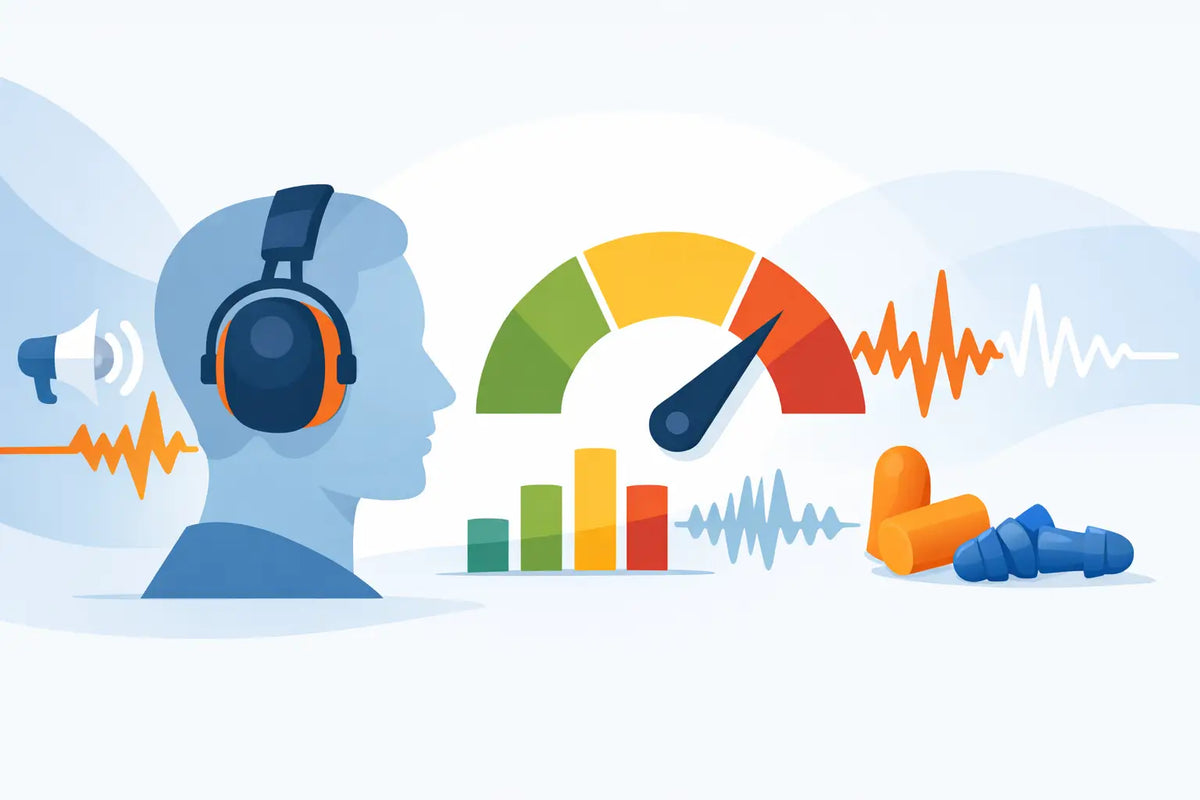
A high noise protection rating can look reassuring on the pack. But if your earplugs leave you unable to follow speech, miss announcements, or feel tempted to take them out halfway through the day, that number has stopped being useful.
That is the problem with judging hearing protection on rating alone. The right product is not simply the one that blocks the most sound. It is the one that reduces harmful exposure to a safer level while still letting you function normally in the real world.
What a noise protection rating actually means
A noise protection rating is a standardised way to show how much sound a hearing protection product can reduce under test conditions. In simple terms, it gives you a benchmark for attenuation - the reduction in noise reaching the ear.
That sounds straightforward, but the real-world meaning depends on how the product is worn, what type of noise you are exposed to, and whether you need to hear speech, music, alarms, or environmental cues. A rating is useful, but it is not a promise that every wearer will get exactly that result.
Different regions use different systems. You may see SNR in the UK and Europe, while NRR is more common in the United States. These figures are related in purpose but not interchangeable at face value because they are based on different testing methods and labelling conventions.
Noise protection rating and real-world performance
This is where many people get caught out. Laboratory testing is controlled. Daily life is not.
If an earplug is inserted poorly, breaks its seal when you talk, or becomes uncomfortable after an hour, the effective protection can drop sharply. The same is true if you are moving between noise levels throughout the day and repeatedly removing and reinserting the product.
A very high rating can also create a different problem. Over-attenuation may leave sound feeling dull or disconnected. For musicians, event staff, regular flyers, commuters, and anyone working around people, that can make protection less practical. When hearing protection interferes too much with communication or situational awareness, people often stop using it consistently.
That is why audiology-led hearing protection focuses on the balance between attenuation and clarity. The goal is not silence. The goal is safer listening without cutting you off from the world around you.
The most common ratings you will see
SNR
SNR stands for Single Number Rating. In the UK and across Europe, this is one of the most familiar ways to indicate overall sound reduction. It gives a simple headline figure in decibels, making it easier to compare products quickly.
That simplicity is helpful, but it also has limits. Noise is not one uniform thing. Low-frequency engine rumble, mid-frequency machinery noise, and high-frequency impact sounds do not behave the same way, and protectors do not attenuate them equally.
H, M and L values
Some hearing protection products also show H, M and L values. These refer to high, medium, and low frequency attenuation. They offer a more detailed picture than a single SNR figure.
This matters if your environment has a particular noise profile. A person exposed to aircraft cabin noise, amplified music, or industrial equipment may benefit from looking beyond the headline number and considering which frequencies need managing most.
NRR
NRR stands for Noise Reduction Rating. You may encounter it when comparing products sold internationally. It serves a similar purpose to SNR, but it is derived differently, so comparing an NRR product directly with an SNR-labelled product can be misleading.
If you shop across markets, the safe approach is to treat each rating system within its own framework rather than assuming the higher-looking number is automatically better.
Why the highest rating is not always the best choice
For very loud environments, strong attenuation is essential. But more protection is not always better in every situation.
If you are at a gig, for example, you may want to reduce volume without flattening the sound. If you work in a workshop or on site, you may need protection that reduces harmful noise but still allows you to hear instructions and warning signals. If you are travelling, you may want relief from engine noise without missing announcements.
In each case, a moderate or carefully tuned level of attenuation may be more useful than the maximum possible reduction. Comfort matters too. A product that is worn correctly for the full exposure period is more protective than one with an impressive rating that spends half the time in your pocket.
Fit changes everything
Two people can use the same earplug and get very different results. Ear canal shape varies. Insertion technique varies. Patience varies.
Foam earplugs can perform well when inserted properly, but many people do not fit them deeply enough. Reusable earplugs may be easier to position consistently, though comfort and seal still depend on the design and the wearer. Filtered earplugs introduce another factor by aiming to reduce sound more evenly across frequencies, which can preserve clarity better than basic blockers.
This is why hearing protection should be judged by more than one number on a label. The noise protection rating tells part of the story. Fit, comfort, and acoustic design tell the rest.
How to choose the right noise protection rating
Start with your environment. Are you dealing with continuous industrial noise, occasional loud leisure noise, travel noise, or short bursts of impact noise? The answer changes what level and style of protection make sense.
Next, think about what you still need to hear. If speech intelligibility matters, avoid choosing purely on the highest attenuation figure. Look for hearing protection designed to reduce harmful sound while keeping communication clearer. That is especially relevant for musicians, hospitality staff, tradespeople, motorcyclists, and frequent travellers.
Then consider duration. For long wear, comfort is not a luxury. Pressure, heat, and poor fit often lead to inconsistent use, which reduces protection in practice.
Finally, be realistic about your habits. If you want something for concerts but know you will not tolerate a bulky or muffling product, choose a solution you will genuinely keep using. Consistency protects hearing. Good intentions do not.
When ratings matter most
There are situations where the rating deserves close attention. If you are exposed to regularly high sound levels at work, a suitable and compliant level of protection is a serious health decision, not a convenience purchase. The same applies if you already experience tinnitus, sound sensitivity, or concerns about hearing changes after noise exposure.
In those cases, broad consumer advice has limits. Personal risk depends on noise level, exposure time, and hearing history. If you are unsure, professional guidance is worth it.
An audiology-informed approach can help match protection to both your environment and your hearing goals. That may mean stronger attenuation, flatter frequency response, better comfort for long wear, or a design that supports clearer speech.
The question behind the number
Most people are not really asking, "What is the highest noise protection rating I can buy?" They are asking, "What will protect my hearing without making daily life harder?"
That is the better question. Hearing protection should help you stay safe and stay connected. You should be able to lower risk without losing the detail that matters - conversation, awareness, and sound quality.
A strong rating has value. So does comfort. So does clarity. The best hearing protection brings those together in a way you will actually wear.
Jett Maxwell builds around that principle: block noise, keep clarity, and hear tomorrow.
When you compare products, do not stop at the number. Ask what the protection will feel like after two hours, whether you will still hear what you need to hear, and whether you will trust yourself to use it every time. That is where better hearing decisions usually begin.