
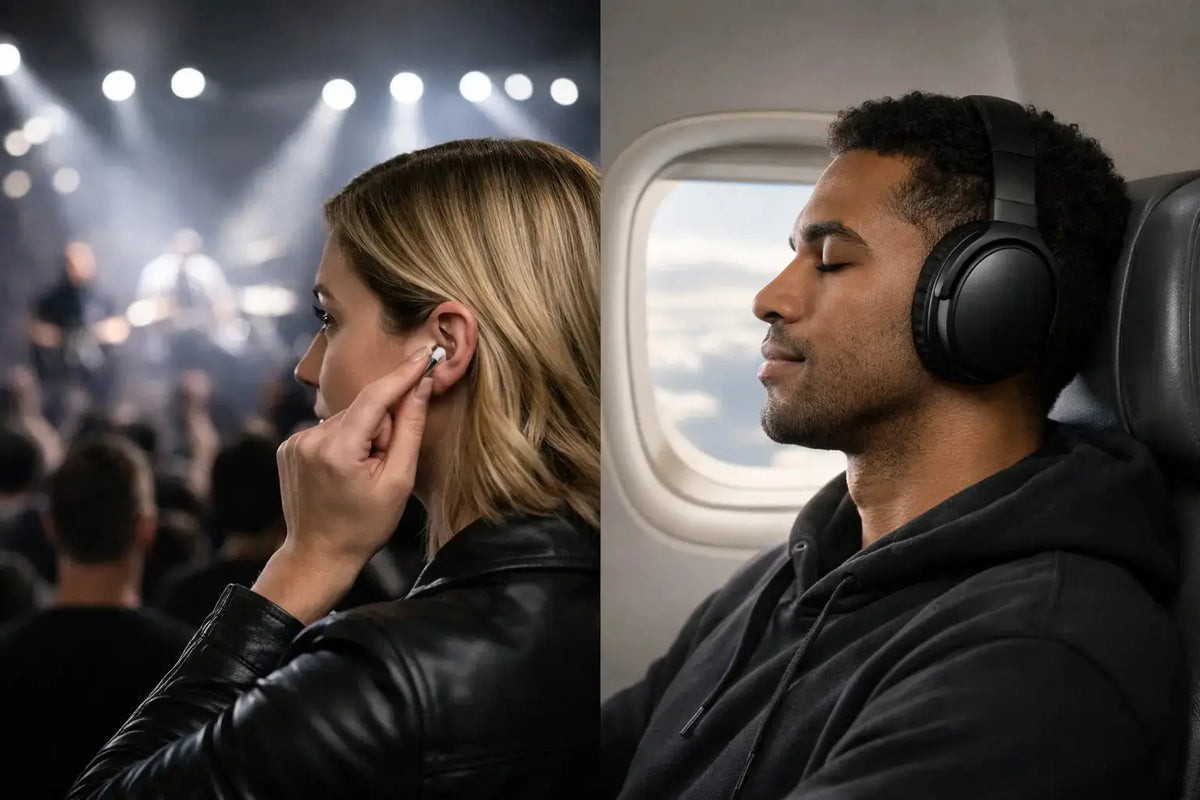
A packed train, a long-haul flight and a loud gig can all feel noisy, but they do not call for the same solution. When comparing earplugs vs noise cancelling headphones, the key question is not simply which makes things quieter. It is whether you want to protect your ears from louder sound, reduce tiring background noise, listen to audio more comfortably, or stay connected to the people around you.
Both can be useful. They just work differently, and choosing the right one can make a meaningful difference to comfort, clarity and how you manage sound day to day.
Earplugs vs noise cancelling headphones: the core difference
Earplugs are worn in the ear canal and reduce the sound reaching your ears. Their purpose is straightforward: lower the volume of the environment. How natural that reduction feels depends on the design. Traditional foam plugs can be effective at reducing sound, but often make speech and music feel muffled. Filtered reusable earplugs aim to lower overall noise while retaining more balance and definition.
Noise cancelling headphones use microphones and electronics to identify steady external sound, then produce an opposing signal to reduce what you hear. They are particularly good at soft, continuous low-frequency noise, such as the hum of aircraft engines, rail travel, air conditioning or a bus journey.
That distinction matters. Active noise cancelling is primarily a listening-comfort feature. Earplugs are purpose-designed hearing protection. Many over-ear headphones also provide passive isolation through their ear cushions, but this is not the same thing as assuming they are suitable protection in every loud setting.
When earplugs are the better choice
Earplugs tend to make more sense when the noise itself is the main issue and you do not need to listen to audio. Think live music, busy venues, sporting events, city crowds, loud social spaces or a commute where you want a little more calm without adding another device.
For music and conversation, sound quality matters as much as volume reduction. A good filtered earplug should not make the room disappear or turn everything into a dull blur. Instead, it should take the edge off while leaving you better able to follow what is happening. This can be especially helpful for musicians, concertgoers and people who find busy sound environments draining.
Reusable earplugs also have practical advantages. They are small, do not need charging and can be carried in a pocket or bag. For regular use, comfort and fit matter more than people expect. An earplug that feels secure, is easy to insert and does not create an overly blocked sensation is far more likely to be worn consistently.
Jett Maxwell Tone-Filter earplugs are designed around this balance: reducing unwanted volume while preserving a clearer, more natural listening experience than conventional foam earplugs.
Earplugs work well for sound sensitivity too
For some people, sound is not always dangerously loud but can still be overwhelming. This may include cafés with clattering dishes, public transport, crowded family events or open-plan offices. Earplugs can help make those environments feel more manageable without requiring complete silence.
The right level of reduction is personal. If you need to hear a colleague, travel announcement or companion, a filtered option may feel more appropriate than a plug that heavily blocks sound. If your aim is rest or sleep, a different style may suit you better. There is no single earplug for every setting.
When noise cancelling headphones are the better choice
Noise cancelling headphones excel when you want to hear something else more clearly. On a flight, for example, reducing the engine drone may allow you to listen to a podcast or film at a more moderate volume. In a shared workspace, they can make background hum less distracting while you focus on music, calls or quiet audio.
They are also useful when the sound around you is relatively constant. The technology is generally less effective against sudden, sharp or irregular noises, such as nearby conversation, a baby crying, clattering plates or the changing volume of a live band. Headphones may soften some of these sounds through the physical seal of the ear cups, but active cancellation is not built to remove every sound.
There is another trade-off: headphones can make you less aware of your surroundings. That may be welcome on a train, but less helpful when crossing roads, moving through a station or waiting for an announcement. Many models offer an awareness or transparency mode, although the experience varies between products.
A useful option for travelling
For travel, noise cancelling headphones can be excellent for entertainment and rest, particularly on aircraft. They can reduce the fatigue of continuous cabin noise and help you enjoy audio without competing as hard with the background.
However, if you simply want less noise while sleeping, reading or sitting quietly, earplugs may be the simpler option. They take up less space, have no battery to manage and do not place ear cups over your ears for hours. Some travellers use both at different points in the journey: headphones for a film, earplugs for sleep.
Can you wear earplugs and noise cancelling headphones together?
You can, but it should be a deliberate choice rather than the default. Combining earplugs with over-ear noise cancelling headphones can create a noticeably quieter experience, which some people value during travel or in very busy environments.
The downside is that it can feel isolating. You may miss announcements, struggle to hear a companion or become less aware of what is happening around you. Comfort can also be an issue, especially if headphone pressure pushes against the ears over a long period.
If you combine them, keep the situation in mind. Avoid using a setup that limits environmental awareness when you need to respond to traffic, staff instructions, alarms or other important cues. And if you are listening to audio through headphones, there is rarely a benefit in turning it up simply because you are wearing earplugs underneath.
What each option cannot do
Neither product creates perfect silence, and neither should be treated as a solution for every noise environment. Earplugs reduce sound but do not remove it entirely. The fit, material and filter design all influence the result.
Noise cancelling headphones reduce certain types of background sound, but they are not a substitute for purpose-designed hearing protection at loud events. Their electronic cancellation is most effective with steady low sounds, not the full range of changing, high-energy sound you might encounter at a concert or venue.
It is also worth being realistic about comfort. Some people dislike the pressure sensation created by active cancellation. Others cannot get on with earplugs until they find the right size or learn a consistent insertion technique. A product only helps if you can wear it comfortably for the time you need it.
How to choose for your situation
Start with the environment rather than the product. If you are heading to a gig, a festival, a loud bar or a motorsport event, choose earplugs designed to reduce volume while keeping sound as clear as possible. If you are settling into a flight with a playlist or film, noise cancelling headphones are likely to offer the better experience.
For everyday sound sensitivity, consider how much awareness you want to retain. A reusable filtered earplug can help take the edge off a busy environment while still allowing conversation. If your challenge is a constant low hum while working or travelling, headphones may be more useful.
Think about practical details too. Earplugs are discreet, compact and ready whenever you need them. Headphones offer audio, calls and adjustable listening modes, but need charging and are usually bulkier. Neither is automatically better. The right choice reflects what you need to hear, what you want to reduce and where you will be using it.
A clearer way to think about sound
The best sound solution is not always the one that blocks the most. Often, it is the one that gives you enough reduction to feel comfortable while keeping the clarity and awareness your situation requires. Use earplugs when protecting your ears from louder environments is the priority. Use noise cancelling headphones when reducing steady background noise makes listening or resting easier.
Giving your ears a break does not have to mean switching off from the world around you. The aim is to choose the level of quiet that lets you stay comfortable, present and ready to hear tomorrow.