
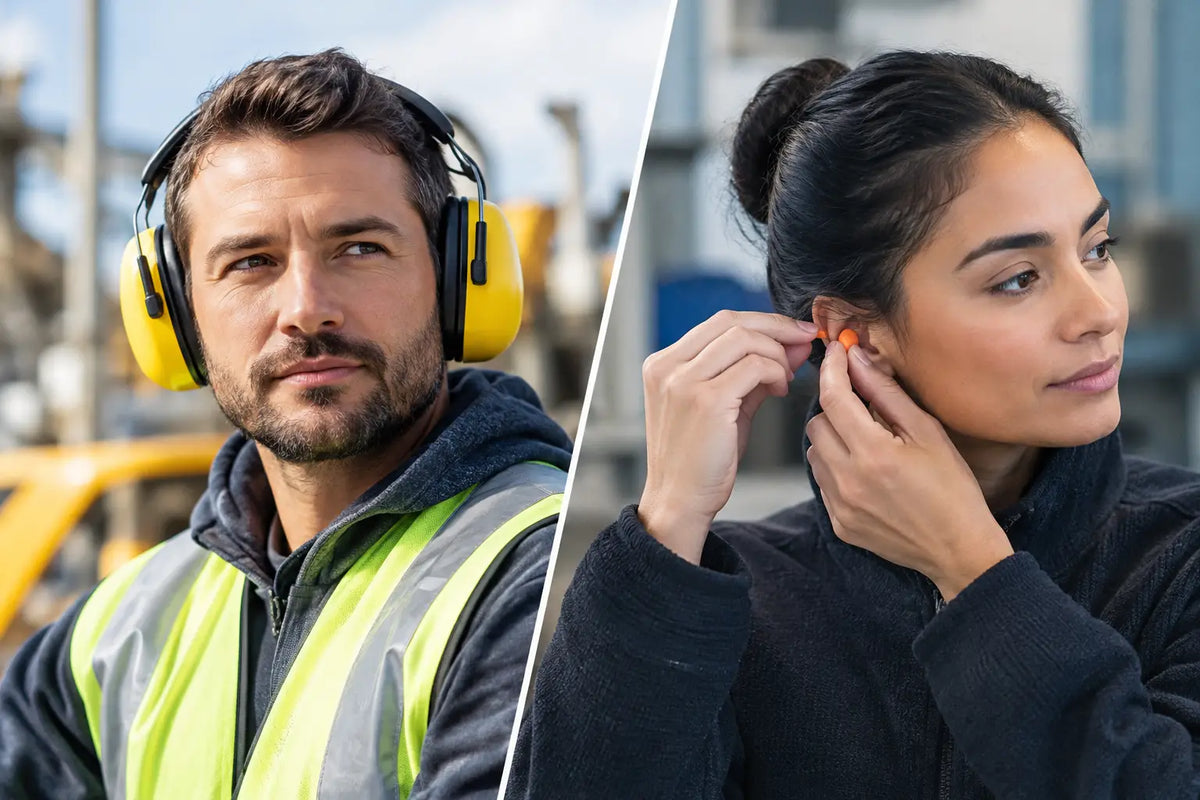
A circular saw starts up beside the loading area, a colleague calls for your attention, and your hearing protection is either helping you work safely or becoming something you keep adjusting. When choosing between earmuffs and earplugs on a worksite, the best option is not simply the one that looks most protective. It must provide the right level of noise reduction for the task, fit properly and work alongside the other PPE you need to wear.
For many people, earmuffs are quicker to put on and easier to check visually. Earplugs can be more comfortable in heat, less intrusive with helmets and glasses, and practical for long shifts. The right choice depends on the noise assessment for your site, the required protection level and whether you can wear the protection correctly throughout exposure.
Earmuffs vs earplugs on the worksite: start here
Hearing protection is a personal protective measure, not a replacement for controlling noise at its source. On a well-managed worksite, employers should first consider quieter equipment, maintenance, barriers, changes to working methods and limiting time in noisy areas. Where hearing protection is required, workers need suitable equipment, clear instruction and a realistic way to use it consistently.
A useful starting point is simple. Choose earmuffs when you need protection that is quick to don, easy to supervise and compatible with the job. Choose earplugs when a secure in-ear fit is achievable and bulk, heat or other head-worn equipment make earmuffs impractical. Neither is automatically better in every setting.
The hearing protection provided or approved for a task should match the workplace noise assessment. Do not assume that reusable earplugs intended for concerts, travel or busy social settings are suitable for occupational noise exposure. Worksite PPE needs to meet the requirements set by the employer and the specific task.
When earmuffs may be the practical choice
Earmuffs sit over the outer ear and form a seal against the side of the head. They are often straightforward to put on, which can be helpful for workers moving in and out of noisy zones or for teams where supervisors need to see that protection is being worn.
They may suit people who find placing earplugs uncomfortable or who struggle to achieve a reliable earplug fit. They can also be convenient for short, intermittent tasks, provided they are worn before entering the noisy area and kept on for the full period of exposure.
There are trade-offs. Earmuffs can feel warm during physical work, particularly in enclosed or hot environments. Their seal can be affected by glasses, thick spectacle arms, facial hair near the cushion area, hair, hooded clothing or the fit of a hard hat. Worn, cracked or flattened cushions can reduce performance, so inspection and replacement matter.
Earmuffs can also be cumbersome where workers need close head clearance, such as in confined spaces or around certain machinery. If they are repeatedly lifted off to hear a colleague or cool down, the protection they offer in practice may be far lower than expected.
When earplugs may be the practical choice
Earplugs sit in the ear canal or at its entrance, depending on the design. They are compact, light and often more comfortable than earmuffs in warm conditions. They may work more easily with helmets, safety eyewear and other head-worn PPE because there is no band or ear cup competing for space.
For long shifts, this can make a meaningful difference. Protection that is comfortable enough to keep wearing is generally more useful than protection that is removed every half hour. Earplugs are also easier to carry, so workers are more likely to have them available before entering a noisy area.
The limitation is fit. An earplug that is inserted too shallowly, the wrong size or poorly positioned may provide much less reduction than intended. Foam earplugs need correct rolling and insertion, while reusable plugs need the right tip size, a clean seal and proper placement. A plug should not be painful, but it should feel secure.
Clean hands are particularly important. In dusty, oily or dirty work, inserting an earplug with contaminated fingers is not sensible. Reusable earplugs also need routine cleaning and checking in line with the manufacturer’s instructions. If they are damaged, misshapen or no longer seal well, they should not remain in use.
Fit matters more than appearance
The stated attenuation on hearing protection gives useful information, but it is not a promise that every wearer will receive the same reduction. Real-world protection changes with fit, wear time, condition and compatibility with other equipment.
This is why fit testing and practical training can be valuable where available. Workers should know how their earplugs are meant to sit, how tightly earmuff cushions should seal and how to spot common issues. A few minutes of instruction can prevent the common habit of wearing protection loosely, incorrectly or only once the noise has already begun.
More attenuation is not always automatically better, either. Excessive reduction can make speech, alarms and changes in the environment harder to hear, depending on the setting. The aim is appropriate protection for the measured risk, alongside safe systems for communication and warning signals. This decision should be led by the site’s assessment rather than personal preference alone.
Communication and awareness need planning
Workers sometimes remove hearing protection because they need to speak to a colleague, hear instructions or stay aware of vehicles and alarms. That is understandable, but removing protection in a noisy area creates a gap at precisely the wrong time.
Instead, the worksite should plan communication. This may include agreed hand signals, quieter briefing points, visual warning systems or suitable communication equipment where the task calls for it. Do not rely on hearing protection alone to solve a wider communication problem.
For people who find complex sound tiring or overwhelming, a busy worksite can be especially demanding. Comfort, pressure around the ears and the feeling of reduced awareness may all influence what is tolerable. These experiences are valid, but occupational hearing protection still needs to be selected against the job’s noise requirements. If standard equipment is difficult to wear, raise it with a supervisor, health and safety lead or occupational health team rather than quietly going without it.
Check compatibility with other PPE
A hearing protector performs as part of a wider PPE system. Before settling on earmuffs or earplugs, consider hard hats, safety glasses, visors, respiratory protection, communication headsets and clothing required for the task.
Earmuff bands may be designed to fit with particular helmets, but not every combination will work as intended. Spectacle arms can create small gaps under ear cushions. Earplugs avoid this particular issue, although they may be unsuitable if a worker cannot obtain a stable fit or needs a different approved solution.
Ask for a practical trial in the actual work setup where possible. The question is not just, “Can I wear these?” It is, “Can I wear these correctly for the whole task, with every other item of PPE in place?”
A sensible way to make the choice
Start with the workplace noise assessment and the hearing protection specified for the area. Then consider the task duration, temperature, hygiene conditions, communication demands and other PPE. Try the approved options with proper instruction, and check whether the fit remains reliable while moving, bending, wearing a helmet or using safety eyewear.
If you already have hearing loss, tinnitus, sound sensitivity, ear discomfort or repeated difficulty understanding speech, an audiologist can discuss your hearing concerns in a personalised way. That conversation does not replace the employer’s duty to provide suitable occupational protection, but it can help clarify what you are experiencing and what questions to take back to the workplace.
The best hearing protection is the one approved for the task, fitted correctly and worn for the full time you need it. If that is not happening, the answer is not simply to tolerate discomfort - it is to ask for the fit, equipment or work arrangement to be reviewed.