
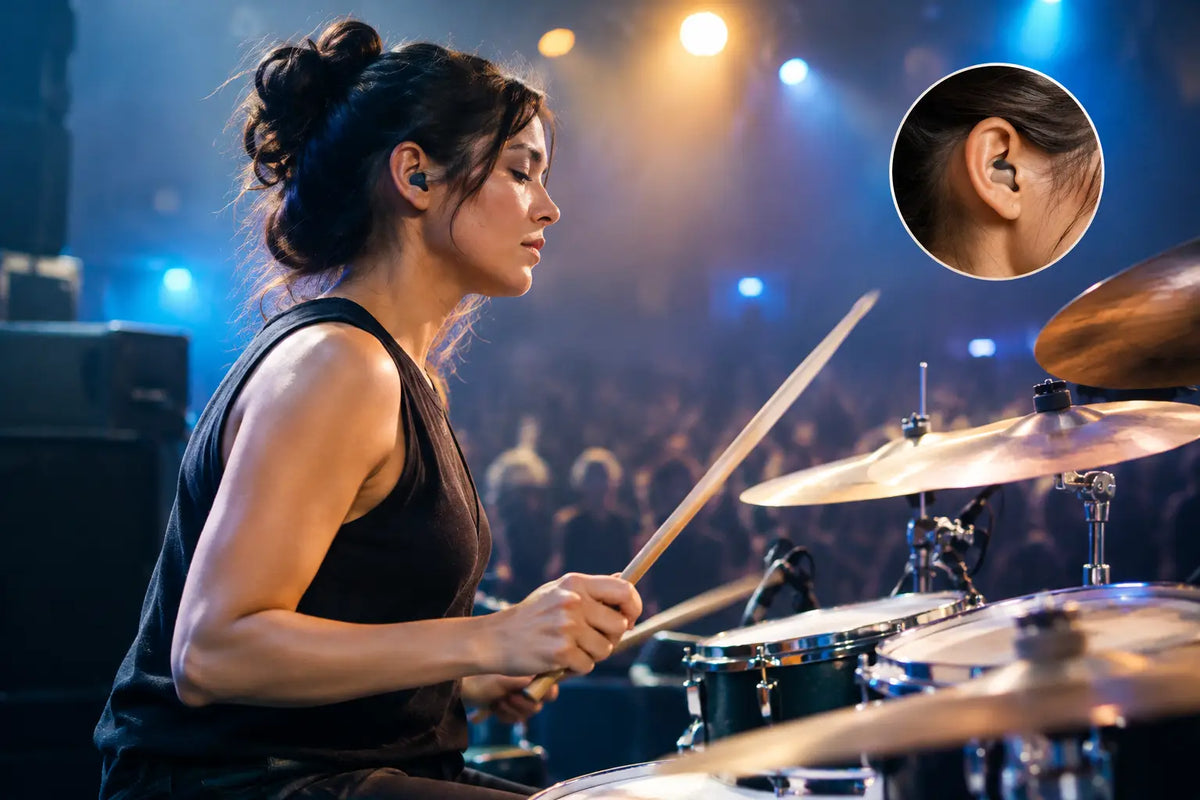
A cymbal hit at close range is not like background noise in a busy pub. It is fast, bright and repeated, often for hours at rehearsal or on stage. The best filtered earplugs for drummers reduce that intensity while keeping the kit, band and spoken cues recognisable. They should make playing more comfortable without leaving you feeling cut off from the music.
There is no single best option for every drummer. The right choice depends on how loudly you play, where you rehearse, whether you need to hear a click or musical detail, and how reliably the earplugs stay sealed during a set. For most players, reusable earplugs with acoustic filters are a stronger starting point than basic foam plugs.
What makes filtered earplugs better for drumming?
Filtered earplugs use an acoustic filter to reduce incoming sound more evenly than simple foam plugs often do. In practice, this can mean less harshness and lower overall level while preserving a more natural sense of pitch, balance and speech. The sound will still be quieter, as it should be, but it need not become a muffled blur.
That matters behind a drum kit. Drummers need to judge cymbal decay, hear when a guitarist changes section, follow a musical director, and respond to a bandmate speaking between songs. Earplugs that reduce everything indiscriminately can make these tasks harder, particularly in a small rehearsal room where sound reflects from walls and ceilings.
Filtered earplugs also allow for a more realistic relationship with your own playing. If protection makes the kit sound dramatically dull, there can be a temptation to play harder or ask others to turn up. A balanced reduction makes it easier to make sensible volume decisions.
How to choose the best filtered earplugs for drummers
Start with attenuation, which simply means how much sound the earplug reduces. More reduction is not automatically better. A quiet acoustic rehearsal, a loud amplified gig and a drum booth with headphones create very different listening demands.
Choose an attenuation level for the setting
For many rehearsals, moderate attenuation can offer a useful balance between comfort and awareness. You may still hear conversation at close range and retain a reasonable impression of the mix, while taking the edge off the kit and amplification.
Higher attenuation may be more appropriate when playing close to loud cymbals, amplification or monitor wedges, or when sessions run for a long time. The trade-off is that communication and subtle musical detail can become more difficult to hear. Some drummers prefer different filter strengths for rehearsal and performance rather than expecting one setting to suit every environment.
Published attenuation figures are helpful, but they are not a promise of what reaches your ear. The real-world result depends heavily on fit, ear shape and how the earplug is inserted. Sound is also made up of different frequencies, so two products with a similar single-number rating may not sound identical when worn.
Prioritise fit before features
An excellent filter cannot compensate for a poor seal. If an earplug works loose when you are moving your head, talking, sweating or wearing headphones, its protection and sound balance can change during a session.
Look for reusable earplugs with more than one tip size where possible. The correct tip should sit securely and comfortably in the ear canal, without pain, pressure or a constant need to push it back in. A smaller tip is not necessarily more comfortable if it leaks sound; an oversized tip may cause soreness and discourage you from wearing it.
Insert earplugs before the room becomes loud, then take a moment to check the seal. Your own voice may sound fuller when the ear canal is sealed, which is normal. What matters is whether external sound has reduced consistently in both ears and whether the fit remains stable.
If you repeatedly struggle to achieve a seal with universal tips, custom-moulded hearing protection can be worth discussing with an audiologist. It is a more individual route, particularly for people who play frequently, but suitability and budget vary.
Consider the sound balance, not only loudness
Drummers often describe poor earplugs as making the kit sound distant or woolly. This is usually a question of frequency balance. A well-designed acoustic filter aims to reduce sound while retaining enough clarity for music to remain enjoyable and usable.
Pay particular attention to how you need to hear cymbals and vocals. Cymbals can be tiring because of their high-frequency energy, but removing too much top end may make timing and dynamics harder to judge. Likewise, if vocal cues are important, choose protection that does not make speech unnecessarily unclear.
The best way to assess this is in a realistic but controlled setting: a normal rehearsal rather than a quick test in a quiet room. Give yourself time to adapt. Protected sound initially feels unfamiliar to many players, especially if they have spent years rehearsing without earplugs.
Rehearsal, gig and studio needs are different
A rehearsal room is often the toughest environment because every player is close together and there is little control over reflections. Here, filtered earplugs can help reduce the cumulative strain of repeated sessions while letting you stay connected to the band.
On stage, the right approach depends on monitoring. If you use wedges, the drum kit and stage volume can combine quickly. Filtered earplugs may be a practical option where you need environmental awareness and clear interaction with the band. If you use in-ear monitors, the situation is different: their fit, isolation and listening level all need careful management. Do not assume that any earplug should be worn underneath monitors unless it is designed and approved for that use.
In a studio, quieter playing and close microphone work may call for less attenuation, if any. Yet studio sessions can still include loud takes, headphone playback and long periods around instruments. Keep your protection available and use it according to the actual level in the room, not just the label of the session.
Common mistakes that reduce the benefit
The most common mistake is only wearing earplugs once the room already feels uncomfortably loud. Put them in before soundcheck or before the first song. This helps make hearing protection part of your normal kit setup, alongside sticks, keys and a drum mat.
Another mistake is treating a pair of reusable earplugs as maintenance-free. Clean the tips as directed, allow them to dry fully and inspect them for damage. Replace worn parts where appropriate. A blocked or damaged filter may affect both hygiene and sound.
It is also worth avoiding the all-or-nothing approach. Taking one earplug out to hear a bandmate creates uneven listening and leaves one ear less protected. If communication is difficult, address the stage setup, agree hand signals, move closer when speaking, or choose an attenuation level that better suits the job.
When to ask for individual advice
If you have ongoing tinnitus, unusual sound sensitivity, ear pain, a sudden change in hearing, or difficulty understanding speech that concerns you, arrange an assessment with an audiologist or other appropriate clinician. Filtered earplugs can be useful hearing protection, but they do not diagnose or treat an underlying hearing concern.
Individual advice can also be useful if universal earplugs never feel secure, if one ear fits very differently from the other, or if you need protection for frequent professional work. An audiologist can discuss fit, listening environments and custom options in the context of your own needs.
For drummers, the right earplugs are the pair you can wear correctly for the full rehearsal or set. A reusable filtered option, such as those developed by Jett Maxwell, is designed around the balance most players need: meaningful sound reduction, clearer music and reliable everyday comfort. Start with fit, choose attenuation for the room, and make hearing protection as routine as warming up before you play.