
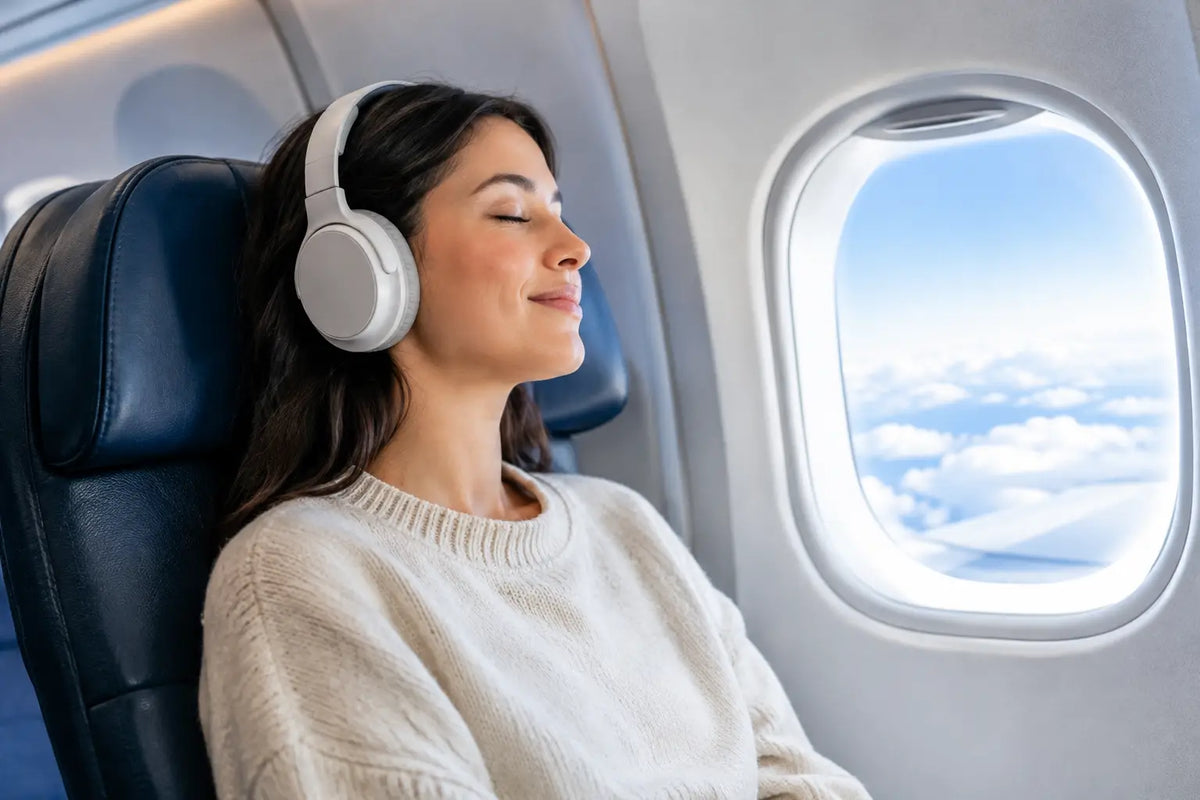
Aircraft cabins are noisy, dry and busy places, but the ear discomfort many people notice on a flight is not all caused by sound. This air travel ear protection guide separates the two main issues - noise exposure and cabin-pressure changes - so you can choose support that matches the journey you are taking.
For most passengers, a well-fitting pair of reusable filtered earplugs can make the cabin feel less tiring while still allowing conversation, announcements and environmental awareness. They can be particularly useful on a long-haul flight, a busy airport transfer or when travelling alongside a noisy group. They do not, however, replace the body’s normal process of equalising pressure through the ears.
Why ears can feel uncomfortable when flying
As an aircraft climbs and descends, the air pressure in the cabin changes. Your middle ear needs to adjust to that change via the Eustachian tube, which links the middle ear to the back of the nose and throat. When equalisation is delayed, you may notice fullness, popping, muffled hearing or discomfort.
Descent is often the more noticeable phase. It is also the time to be awake and proactive rather than relying on your ears to sort themselves out after landing. Swallowing, yawning, chewing gum or sipping water can encourage the muscles around the Eustachian tube to work. Some people find gentle pressure-equalising techniques helpful, but forceful attempts can make an already irritated ear feel worse.
Noise is a separate consideration. Engine sound, airflow, cabin service, crying children and the general hubbub of a full flight can add up, especially if you are tired, sensitive to busy sound or using the journey to recover from a loud event. Reducing this background level can make speech easier to follow and help the whole trip feel more manageable.
What earplugs can and cannot do on a plane
Reusable filtered earplugs reduce incoming sound without trying to shut you off completely. Compared with solid foam plugs, which can significantly muffle speech and change how your own voice sounds, filtered designs are intended to lower the overall level more evenly. The result may feel more natural for listening to a companion, a cabin announcement or entertainment at a sensible volume.
This makes them a practical option for airport terminals as well as the flight itself. A crowded departure lounge can be acoustically demanding: rolling cases, public-address systems, coffee machines and overlapping conversations all compete for attention. Taking the edge off can reduce listening effort without requiring total isolation.
It is worth being precise about their limits. Standard hearing-protection earplugs are designed for sound reduction, not for managing cabin pressure. Some travel-specific products are marketed for pressure changes, often with a specialised airflow design. Whether they are suitable for you depends on your ear history, comfort and the instructions provided with the product. Do not assume that any earplug will prevent pressure discomfort.
No earplug removes every sound or guarantees protection from harm. Fit, seal, duration of use and the surrounding noise all matter. If you use earplugs with headphones, avoid increasing the headphone volume simply because the sound feels different.
Choosing ear protection for air travel
Start with the situation you want to improve. If your priority is reducing the relentless noise of travel while retaining useful awareness, reusable filtered earplugs are usually the most versatile choice. For a short flight where pressure changes are your main concern, a product specifically designed for that purpose may be more relevant.
Comfort matters more than people expect. An earplug that presses, works loose or creates an overly sealed feeling is unlikely to stay in place for a full journey. Reusable options commonly come with different tip sizes. The correct size should sit securely in the ear canal without pain, and it should not need to be pushed deeply into the ear.
Consider the following before packing:
- Your flight length: A comfortable, reusable option is particularly useful for longer journeys and airport waiting time.
- Your sound needs: Choose a filter level that reduces the noise you find fatiguing without making speech and announcements unnecessarily difficult to hear.
- Your usual ear comfort: If you dislike the sensation of an occluded ear, trial the earplugs at home first rather than making the flight your first experience.
- Your plans at the other end: The same earplugs may be useful for a concert, festival, city break or busy public transport after landing.
Getting the fit right before you leave
A good fit is central to both comfort and performance. Clean hands first, then gently place the earplug according to its instructions. You may find it easier to reach over your head and lightly pull the outer ear upwards and backwards to straighten the ear canal. Insert the plug only as far as needed for a stable, comfortable seal.
The sound should become quieter, not necessarily silent. If one ear seems noticeably less protected than the other, or the plug repeatedly shifts, try another tip size if available. A larger tip is not always better: excessive pressure can cause discomfort, while a tip that is too small may not seal consistently.
Give yourself time to adapt. Hearing your own voice and chewing sounds differently is common when the ear canal is partially blocked. This effect is often more apparent with a fuller seal. Wearing your earplugs around the house, on a train journey or in a café before flying gives you a clearer sense of how they feel and how much reduction you prefer.
A practical routine for take-off and landing
Put your hearing protection in when the airport environment becomes noisy, rather than waiting until the cabin is already overwhelming. If you prefer to hear boarding information clearly, keep volume reduction moderate and stay attentive to announcements and crew instructions.
During take-off, use earplugs for noise comfort if they suit you. As descent begins, focus on pressure equalisation. Stay awake if possible, keep a drink to hand and swallow regularly. Remove or adjust your earplugs only if doing so feels more comfortable for you and is consistent with the product guidance. There is no single rule that suits every ear.
If you are travelling with a cold, nasal congestion or an active ear problem, pressure equalisation may be more difficult. Pharmacists, GPs and audiology professionals can offer individual advice where appropriate. Seek medical assessment promptly for severe ear pain, discharge, marked hearing change, dizziness or symptoms that continue after a flight.
When sound feels more demanding than it does for others
People experience busy sound differently. You may not have a hearing loss, yet still find the airport and cabin exhausting because your brain is working hard to separate speech from background noise. This can also be true for people with tinnitus, sound sensitivity, auditory processing difficulties or neurodivergent sensory preferences. Ear protection can be a useful comfort strategy, but it is not a treatment for any of these experiences.
The key is to avoid an all-or-nothing approach. Complete isolation may feel reassuring in the moment but can make communication with staff, travelling companions or emergency instructions harder. A filtered earplug offers a middle ground for many people. On particularly demanding journeys, combine it with quieter boarding choices where available, breaks from headphones and a little extra time between connections.
Pack your earplugs where you can reach them before the terminal gets loud. A small preparation step can make the journey feel calmer, while leaving you able to hear the moments that matter.